


Before you : the three checks that matter for Gold Purity.
Do not judge a gold ornament by its colour, shine or the seller’s assurance alone. Before paying, inspect the BIS hallmark, read the purity grade, and verify the six-character Hallmark Unique Identification (HUID) number through the BIS CARE app. Ask for an invoice that records the item’s weight, purity, rate and charges. For a high-value purchase or a genuine doubt about the metal, ask a BIS-recognised Assaying and Hallmarking Centre (AHC) about the appropriate testing procedure.
These steps reduce risk, but they are not interchangeable. HUID verification checks the record associated with the hallmark; it is not the same as a fresh laboratory assay of the physical ornament. A surface X-ray fluorescence (XRF) reading also has limitations. Understanding what each check can—and cannot—establish is the key to buying with confidence.
Why gold purity checks are back in the spotlight
A report published in November 2026 has raised questions about whether a heavy metal called rhenium could be used to increase the weight of a gold ornament without being identified by some routine testing. The report describes an experiment conducted by a Dainik Bhaskar team with a jeweller in Jodhpur. It has attracted attention because the ornament reportedly passed checks and received a 22-carat hallmark.
The reported experiment used 7.830 grams of 24-carat gold and 1 gram of rhenium. A further 0.75 grams of alloying metal was added during the jewellery-making process, producing a finished ornament weighing 9.580 grams. The report says that the ornament was presented to testing centres and showrooms in Jodhpur and was reportedly assessed as 22-carat.
A simple calculation using the reported starting quantity of gold gives 7.830 ÷ 9.580 × 100, or approximately 81.7 per cent gold by finished weight. That is materially below the 91.6 per cent gold content associated with 22-carat/916 fineness. This calculation is based on the quantities reported in the news investigation; it is not an independent laboratory assay of the finished ornament.
That distinction matters. The report is a serious reason to ask questions about testing and quality control, but one reported experiment does not establish how common such adulteration is in the market. Nor does it independently prove that every hallmarking centre or every XRF instrument will fail to identify rhenium. The All India Gem and Jewellery Domestic Council said it had alerted BIS over reports of suspected rhenium- and iridium-based adulteration and urged tighter checks. Its statement is an industry response, not a published prevalence study or a substitute for independent test results
What do 22K, 24K and 916 actually mean?
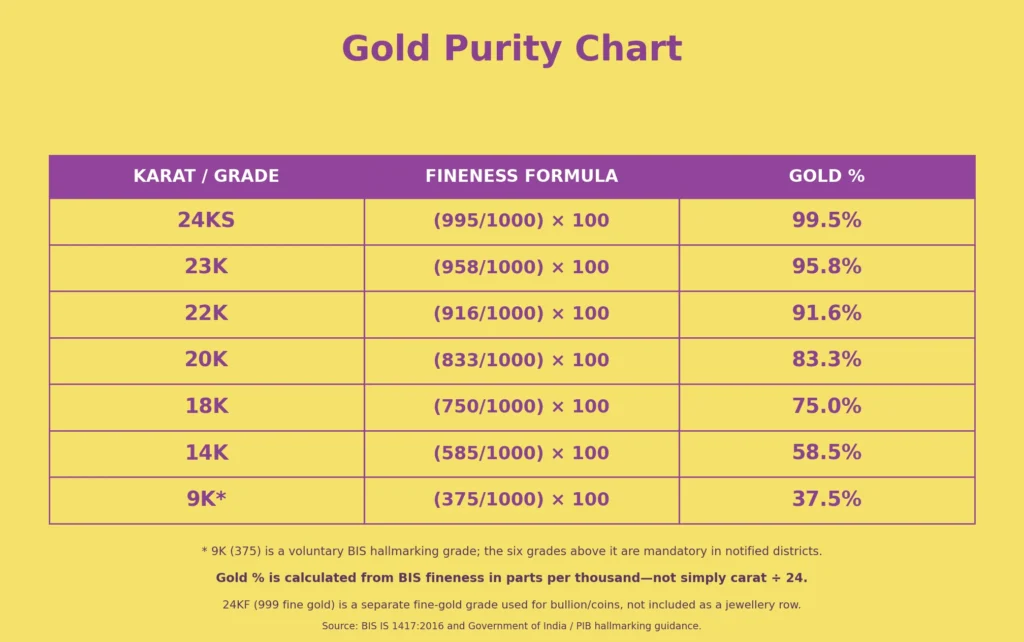
Carat (often written as K) expresses the proportion of gold in an alloy out of 24 parts. 24-carat gold is conventionally treated as nearly pure gold, while 22-carat gold contains 22 parts gold out of 24. In fineness notation, 22K corresponds to approximately 916 parts gold per 1,000 parts of the alloy—hence the familiar 22K916 marking.
The remaining portion of a 22-carat ornament consists of other metals used to give the piece strength, colour or workability. The presence of alloying metals is not, by itself, evidence of fraud. The question is whether the actual gold content and composition match the declared purity and applicable standards.
How to verify a BIS hallmark and HUID
BIS states that the HUID is a six-character alphanumeric number unique to a hallmarked item. The hallmark on gold jewellery includes the BIS logo, the purity mark in caratage and fineness, and the HUID. Consumers can use the Verify HUID feature in the BIS CARE app.
Locate the BIS logo, the purity/fineness mark (for example, 22K916) and the six-character HUID on the item.
Open the official BIS CARE app and choose the Verify HUID feature.
Enter the HUID carefully and review the details returned by the app.
Compare the record with the physical item and the seller’s description. If the details do not match, pause the purchase and ask the jeweller for an explanation.
Keep a copy of the invoice and, where useful, a record of the HUID verification.
BIS’s November 2026 public information also describes additional app information, including photographs and recorded details intended to help consumers compare the physical article with its digital record. App features can change, so follow the current instructions displayed in the official app.
What HUID verification does not do
A successful HUID lookup confirms that the identifier corresponds to a BIS hallmarking record and provides the associated information available through the system. It does not mean that the buyer has independently tested the entire physical ornament at the point of sale. It also does not replace an assay where there is a specific reason to question the composition of the metal. Treat it as an important traceability check—not as a magical detector for every possible form of adulteration.
XRF testing versus fire assay: understand the difference.
X-ray fluorescence (XRF) is widely used because it is fast and does not ordinarily require cutting or melting the jewellery. The instrument analyses the characteristic X-rays emitted by elements near the surface of the tested area. It can be useful for screening, but a surface reading may not represent the composition of the entire ornament, especially if the item is not compositionally uniform.
Fire assay is a laboratory method used to determine gold content in a sample. It is destructive to the sample taken and requires the consumer to understand and agree to the sampling method. BIS consumer guidance explains the procedures available at recognised Assaying and Hallmarking Centres and the limitations that should be stated when a report is based only on XRF. Ask the centre to explain exactly what method will be used, what part of the ornament will be sampled, and what the report can establish.
| Method | What it is useful for | Important limitation |
| BIS hallmark + HUID | Checking the hallmark record and item details | Not a fresh assay of the physical item |
| XRF | Fast, non-destructive surface screening | May not represent the full article’s composition |
| Fire assay | Determining gold content in the sampled material | Destructive sampling; sample selection matters |
| Home tests | At most, crude screening in limited circumstances | Cannot reliably certify purity or detect all adulterants |
Can hallmarked gold still be impure?
A hallmark is an important consumer safeguard, but buyers should not confuse a mark with an infallible guarantee that no error, fraud or process failure can ever occur. The November 2026 Jodhpur report describes one alleged case in which an ornament containing rhenium reportedly passed checks. That is a reason to examine the reported facts and the testing limitations carefully—not a reason to assume that all hallmarked gold is unsafe.
The responsible conclusion is two-sided: buy properly hallmarked jewellery and verify the HUID, while recognising that digital traceability and physical composition testing answer different questions. If a high-value purchase raises a specific concern, seek advice from a BIS-recognised AHC and ask for the test method and its limitations in writing.
A buyer’s checklist before paying
Check the BIS logo, purity/fineness mark and HUID on the ornament.
Verify the HUID through the official BIS CARE app and compare the returned details with the item.
Ask for a proper invoice showing the description, gross and net weight where applicable, purity, rate, making charges and taxes.
Ask the jeweller to explain the testing and hallmarking process if anything is unclear.
Read the written exchange and buyback terms. Ask how deductions for stones, solder, wastage or melting are calculated.
Keep the invoice, payment proof, product details and HUID record.
For a costly item or a credible concern, contact a BIS-recognised AHC before agreeing to any sampling or destructive test.
Can you check gold purity at home?
Not with the reliability needed to certify a purchase. Internet advice often recommends magnets, vinegar, ceramic plates or visual inspection. Such methods may produce misleading results and cannot establish the fineness of a jewellery article. A non-magnetic response, for example, does not prove that an item is 22-carat gold. Do not scratch, file, heat or apply chemicals to a piece you have not purchased or do not own. Use the hallmark and HUID for initial verification, and a recognised testing centre for a formal assessment.
What should you do if the HUID details do not match?
Do not complete the purchase until the discrepancy is resolved. Ask the seller to verify the item and provide a corrected explanation. Keep photographs of the hallmark, the HUID, the invoice or quotation, and any app result. If you have already purchased the item, preserve the invoice and approach BIS through its official consumer channels for current complaint instructions. Avoid making public accusations based only on an unexplained mismatch; record the facts and seek an official assessment.
Should you buy gold because the price has fallen?
A lower market rate may make a planned purchase more affordable, but it does not tell you whether an individual ornament is genuine or whether the price will fall further. Jewellery also includes making charges, taxes and possible resale deductions. Compare the total invoice price, the gold weight and purity, and the seller’s written buyback terms. If the purchase is not urgent, do not let a short-term price headline rush you into a decision.
Frequently asked questions
How do I check whether 22K gold is genuine?
Check the BIS logo, 22K916 purity mark and six-character HUID. Verify the HUID through the BIS CARE app and compare the returned details with the physical item. For a specific concern, ask a BIS-recognised AHC about testing.
What does 916 mean on gold jewellery?
916 indicates approximately 916 parts gold per 1,000 parts of the alloy, or 91.6 per cent gold, which corresponds to 22-carat gold.
Can a fake or incorrect HUID be detected?
Use the official BIS CARE app’s Verify HUID feature. If the HUID is invalid or the displayed record does not match the article, stop and seek clarification from the jeweller and BIS.
Does XRF testing prove the entire ornament is pure?
Not necessarily. XRF readings are generally based on the tested surface area and may not represent the whole ornament. Ask the testing centre to explain the method and its limitations.
Is fire assay more reliable than XRF?
Fire assay is a recognised method for determining gold content in the sample tested, but it requires sampling and is destructive to that sample. The result depends on appropriate sampling and laboratory procedure.
Does the rhenium report prove that all hallmarked gold is adulterated?
No. It describes a reported experiment. It does not establish the prevalence of adulteration across the market or independently prove that all hallmarking centres or instruments are vulnerable.
Can I test gold purity with a magnet at home?
A magnet test cannot certify gold purity. It may identify some magnetic materials, but a negative result does not prove that the item is genuine gold or of the declared carat age.
The bottom line
The safest gold purchase is not based on trust alone or on a single machine reading. Check the hallmark, verify the HUID, insist on a detailed invoice and understand what any test can actually establish. The rhenium report deserves scrutiny, but it should be discussed with precision rather than panic. A careful buyer asks for records, understands the limits of the test and keeps evidence of the transaction.
Sources and further reading
Bureau of Indian Standards (BIS): Hallmarking FAQs and HUID verification
BIS: Consumer guidelines for testing gold jewellery at Assaying and Hallmarking Centres
Press Information Bureau: BIS Hallmarking — The Mark Behind Consumer Trust (5 November 2026)